Iguanas and Fish

Tuesday was a slow day, we took care of some stuff that we wanted to do on the boat before we headed back to Georgetown for Regatta on Wednesday. Sabrina did some sewing while I worked on taking care of some stuff back home.

In between our projects we took the time to head over to Leaf Cay to see the iguanas that frequent the beach on the west side. We motored JV over to Leaf Cay in light winds to check things out. Once we got the hook down, we rounded the west end in the dinghy and could immediately see the iguanas sunning themselves on the rocks. We’ve heard of other cruisers feeding them, but we didn’t bring anything. They obviously were used to handouts and jockeyed for position on the beach.

On Wednesday we woke up and got underway mid-morning.  We had a good wind for sailing, and we put the dinghy on deck so hopefully we’d have better luck fishing.  The wind was out of the ENE and we sailed close-hauled most of the day, we enjoyed the change of pace after so much downwind sailing, and we weren’t too tight on the wind.

After a few hours with no luck, we started to get into some fish. There was a runoff, a knockdown, and finally I was able to coax a mahi onto the line.  We brought him all the way to the boat and I had my hand on the leader when he shook the hook. It was very disappointing because we could really use the meat. About an hour later we hooked up with two, same thing on the first one, he was almost at the boat when he got loose, but the third time’s a charm and we landed a nice 3’ female. The first two we lost were a little bigger, and just not hooked good enough to get in the boat.

Happy with our catch, we sailed into Georgetown as the Wednesday regatta races were going on. We dropped the hook nearby our friends on Anastasia, and made a few runs into town.  The Regatta party was just heating up and Georgetown was transformed into a boomtown of people, food shacks, liquor stands, and advertising tents. The wooden Government dock had been rebuilt and offered a great platform to watch the races. It was quite a change from the first time we pulled into this small town.

Stay tuned for the craziness of Family Island Regatta!

Categories: Uncategorized | Leave a comment

More from the Bight!

 [Cruiser’s note:  Throughout the Bight of Acklins from Long Cay to Camel Point the water held 9 to 11 feet.  Long Cay has some coral at the south end to avoid, but after that it’s an easy cruising ground. We didn’t go south of Delectable Bay, but the chart says it is possible and we hope to try it in the future.  We anchored in 7 feet of water off of Camel Point and there is very little tide difference on that side. Enjoy!]

Easter Sunday in Delectable Bay

The cruising guide for Acklins, like most of the Far Bahamas, is painted with a pretty broad brush, so experiencing these islands requires quite a bit of exploring on your own, which is ok with us.  After arriving at the Delectable Bay anchorage, I wanted to see if there was a church service nearby for Easter the following day, so I took off in the dinghy to see what I could find out. I hadn’t gotten far when I heard an engine behind me, so I turned around to meet Beatrijs and At from Mauyva.  Within a few minutes of making introductions, Beatrijs asked if I minded if she came to shore with me. So the ladies set off for some shore exploration before sunset, leaving the men happily discussing boat technicalities in the cockpit.

An old concrete government pier in ruins marks the entrance to the tiny Delectable Bay settlement. Beatrijs and I wove our way around rocks and bundles of branches while a few curious children playing nearby gathered around the dock. We secured the dingy to a rusted wrench acting as a cleat and made our way down the dirt road to head into town. This area was hit fairly hard by hurricane Irene (and likely several others before her) and the seven or so buildings along the main road still showed the signs.

We had walked past several buildings with no sign of a church when two American women in an SUV slowed  down to talk with us. They told us they were visiting the island for a week, explaining that they had also once sailed the island, together with their husbands, doing research on the native iguanas on Acklins in the 70’s. They generously offered to take us to stores or arrange to pick us up at a later time if there were any errands we needed to run. We thanked them but said there wasn’t much we really needed. They then told us they had spoken to the pastor of a church earlier in the day, and that services would be back up the road at 11:00 tomorrow, so they went on their way with our promises to see them again the following morning.

Beatrijs and I continued up the road just a bit and passed a woman balancing a very large basket of tree branches on her head. She paused to smile and tell us good evening, and we later learned that these were cascarilla branches. The collection of the bark from these trees for sale to Europe for Campari liquor and perfumes is the primary trade of Acklins. The process involves collecting the branches, soaking them (like we had seen at the government dock), and stripping and drying the bark.

We decided to head back to the dinghy as it was getting close to sunset, and as we walked we chatted about where we had been cruising and where we had plans to head next. We passed the building the ladies had told us would host the service, and saw no indication that the building housed a church from the outside, but we peered into a window, and, sure enough, found a pulpit, speakers and chairs lined up for the service. After a wet ride home in the building wind and waves, Beatrijs and At departed for Mauyva with plans to see us again at church the next morning.

Easter morning was still windy, but we dressed for the occasion (Brad even wore socks!) and I put on my foul weather jacket to keep the salt spray from ruining my dress on the way to shore. We arrived at church at 10:55, and there was already a man addressing the congregation of 15 people or so (including the two ladies we met the previous day and the husband of one) from the pulpit. But he smiled and waved us in, so we took chairs near the back. We weren’t late, though, we had walked in on Sunday school, and the church service began about 20 minutes later (island time). A few more people had trickled in during Sunday school to total about 25, including the 7 guests. The people of the congregation seemed genuinely happy to have us there and were extremely gracious. The service was uplifting, lively and LOUD, and I’m certain that those speakers had no trouble reaching all the way to the heavens. We had an opportunity to speak with some of the members after the service and really enjoyed getting to know a little bit about our hosts.

After visiting, we took a quick walk to the house the American women were renting to chat about their time in Acklins, and they presented each of us with an Easter banana. On the walk back to the dinghies, we encountered several other people, a few of whom were just curious about the boats and came out to greet us. (Boats are still a rare occurrence here in Acklins, unlike the rest of the Bahamas.) We chatted with several gentlemen at the government dock where we learned about the process for readying cascarilla for sale and the history of the settlement. They told us of the work involved to prepare cascarilla to be sold: soaking it, stripping the bark, drying it, and selling it dry for about $6 a pound. One man told us about the old cemetery that housed his ancestors and pointed to the stone wall that was his family’s land, but the house had been washed away time and the hurricanes.

Brad and I returned to Joint Venture late afternoon to cook a delicious Easter dinner of pepper gingered pork loin and zucchini casserole.  We were able to make a few phone calls to family that afternoon, and Beatrijs and At joined us again later that evening to share conversation and a carrot cake I had made. All in all it was a lovely Easter, and we are thankful to have been able to spend it in this beautiful place with such generous and gracious people.

Monday the 9th brought calmer weather, and Brad was itching to explore the mangrove swamps near the boat. We had passed several fishermen the previous day, wading with their fly rods in hopes of catching a bonefish. The shallow waters of the Bight of Acklins are apparently excellent for bonefishing, and this tourist trade is also a source of revenue for the islands. After several failed attempts to navigate the dinghy through the shallow waters of the entrance to the mangrove swamps, we anchored the dinghy and waded through the water, searching for signs of the elusive, silver fish. We spotted a few, along with a lot of sea turtles who were surprised to see us. We didn’t want to disturb the fishermen, so we did not venture too far. We’d heard the bonefish lodge can cost upwards of $500 a night, and certainly didn’t want anyone’s expensive fishing vacation to be spoiled by a few curious sailors. Later that morning, though, we were able to find the deep water channel with the dinghy and take a tour of the mangroves. We followed this up with a short coconut hunt to nearby Camel Point that proved fruitless, except for spotting some tasty looking fish near the dilapidated piers of the government dock.

Monday afternoon, we busied ourselves with some boat projects, Brad fixing some issues with the whisker pole rigging while I did some cleaning and waxed the stainless on deck. We enjoyed one more evening with Mauyva before they departed for Mayaguana and parts farther south, thankful to have met this interesting couple and hoping we will cross paths again.

Spring Point and Snug Corner

Tuesday was overcast and cloudy, and after a few more boat chores we decided to head back to the government dock at Camel Point. I wanted to go for a run into the Spring Point settlement so Brad took some fishing poles to see if he could get a closer look at the fish off the pier. The run was a little longer than I expected, and caused me to break into our well-provisioned, but thankfully seldom-used medicine cabinet that evening for some ibuprofen. Still, it was fun to get out for a run and a great way to see some of the island. Brad faired slightly better in his quest and caught a Mutton Snapper and a Horse-Eye Jack that I later filleted. We hadn’t tried either, but our fish guide said that both are good, and we have heard other cruisers rave about Mutton Snapper. We never worry about wasting a fish, though, if we don’t like it, Nermal certainly will! (Update: Sadly for Nermal, I found both fish to be delicious, and he got only a few bites of each.)

Wednesday we decided it was time to do a little more exploring ashore. We took the dingy to a dock several miles north at Spring Point. There are only about 10 buildings in Spring Point, so it didn’t take us too long to make the rounds. We stopped into Nai’s gas station, and then into Nai’s Restaurant across the street. It definitely looked like it was the happening place to be after work and even had the first pool table we’ve seen in the Bahamas. At 11:00 am, however, there were just two men chatting with the woman behind the bar. We asked if they were serving lunch, but they said they were open for drinks only today. We continued on our way, and decided walk north toward the store that was supposed to be on the northern limit of the settlement.

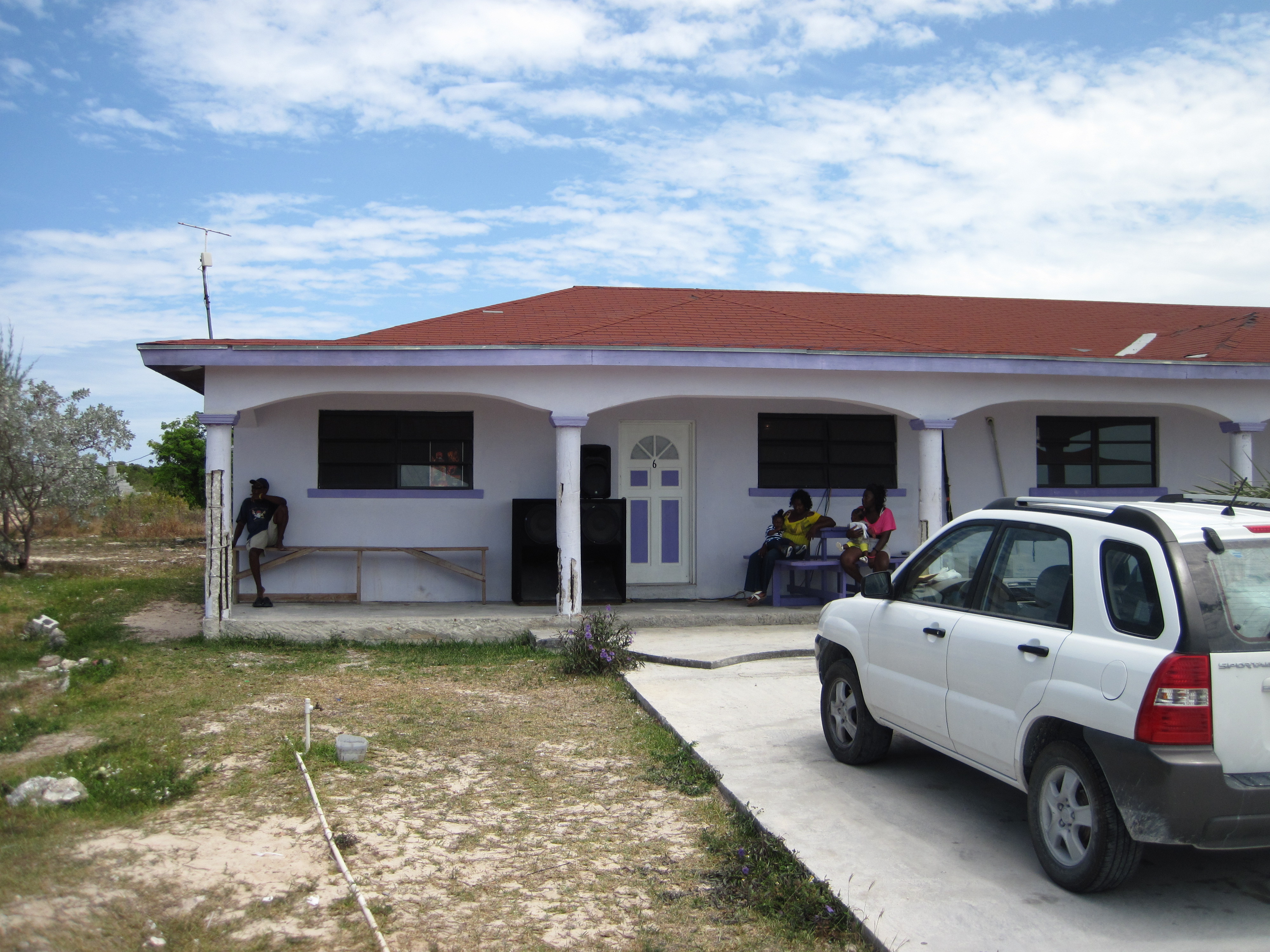
Hitchhiking is very common in the outer islands of the Bahamas, and we have met many cruisers who travelled much of Long Island this way, meeting lots of interesting people along the way. As Brad and I were debating whether or not to try to hitch a ride, a van pulled up beside us. The two men we’d seen at Nai’s Restaurant were on their way north and asked if we wanted a ride. They said they’d be happy to drop us off at a restaurant and store in Snug Corner, and informed us the store we were heading for was closed. We hadn’t reached a decision about hitching a ride, but it seemed to be made for us, so we hopped in.  We made some small talk, but then the men engaged in a lively discussion of politics among themselves so Brad and I just enjoyed the scenery until we saw a little town. They pointed out the “restaurant” we should go to, it was the first door of a small purple and white apartment complex. “Number 6 – that’s where you want to go,” they said. Then they dropped us off up the street at a small store. When we found the door locked, they began yelling loudly to the little house next door for a woman to open it up. We told them we’d just stop back later, and thanked them for the ride.

We decided to explore the town a bit before heading back to apartment “Number 6.” We walked past some homes and what looked like an abandoned school before we came to the R/O water facility, with a small office building, a half size container, and 5 water tanks. We impulsively decided to go inside. There were three men inside, busy discussing and sending a fax. They asked if they could help us, and not knowing why we were there, really, we said we were just walking by and were curious about the facility and stopped in to say ‘hi.’ One of the men started to warm up at that and smiled and said if we were interested he’d be happy to give us a tour.

So, Kendrick led us outside and showed us the half size container that housed the whole R/O operation. He explained the process and said it made 1200 gallons of water an hour that supplied Snug Corner and was trucked to several other nearby settlements. We chatted for a while and he told us we should head back to town for lunch. “Number 6?” we asked and he laughed and said yes. He explained that Club Rollex (which was listed in the guidebook) was damaged during hurricane Irene, so the owner had moved the restaurant into a vacant apartment that he owned. Ahhh… it all makes sense now, sort of…

Well, of course we had to eat at “Number 6” after several recommendations, so we headed back and enjoyed a delicious lunch of grouper fingers, fried chicken and French fries along with quite a few regulars. Imagine a two-bedroom apartment with a retro-fit fryer and exhaust hood and a four stool bar at a breakfast nook.  The rest of the living room was filled with tables where you could play backgammon over lunch, or play dominos outside on the picnic table. Over this tiny space loomed the massive sound equipment that no doubt used to be housed in Club Rollex. After lunch, we stopped back into the store, which was now open, for a bottle of water before beginning the long walk home.

When we started walking, we could barely see the BTC tower in Spring Point where we’d left the dinghy. There was a bonefishing lodge on the chart only a few miles from Snug corner, and we thought we had passed it in the van. Brad wanted to see if he could get some new flies to make an attempt at the bonefish, so we decided to walk that far before we started looking for a ride. When we arrived, we realized the building we’d seen was not the fishing lodge, and the sign said IVel’s Bed and Breakfast. We walked a little closer, and the owner ldell came out and asked where we were headed. She asked if she could show us around and gave us a tour of the whole facility. If you ever need a place to stay on Acklins, remember IVel’s Bed and Breakfast! It is immaculately clean and beautifully decorated. After the tour and some lovely conversation, she insisted on providing a ride back to Spring Point and gave a set of keys to a woman who worked for her.

We had a fun ride back – she thought we were crazy to have thought of walking the whole way, and spent several miles telling us so. She told us a little more about the island and the regatta and homecoming they have every year and asked us if we were the ones who went to church in Delectable Bay on Easter. Apparently, one of the men we talked with after the service is also the cook at IVel’s. It is a very small island, and we definitely stood out as ‘the visitors from Maryland!’ She dropped us off near the dinghy, and we headed back to the boat, tired, and incredibly thankful we didn’t have to walk the whole 14 miles back!

Flamingos, Long Cay and Albert Town

The following morning, we sailed off the anchor to head back to Long Cay to do some flamingo watching. With much more wind than we had on the way over, we made quick time and anchored with plenty of time to go ashore. A small group of flamingos was in the same place we had left them several days earlier, so we took the dinghy over to see if we could get a closer look. We landed the dinghy on a beach near some mangroves around the corner from where the flamingos were gathered. We were able to slowly move around to the other side of the bank and get some pictures.

After the flamingos, we made our way to the dock by the road that leads to Albert Town. There were several fishermen and boats already there, and they waved us around to dock in front of their larger boats. They had been conching and were cleaning their catch. They each had the largest pile of conch in front of them we have ever seen. It would have taken us days to clean half that many conch, but we knew they hadn’t been there that long, since we’d seen them still out on the boats when we were anchoring only a few hours earlier. We stopped to talk to them, but they had already attracted quite a crowd. There were hundreds of crabs in the shallow water surrounding the dock, and lots of sea birds flying around waiting for a chance to get an easy meal.

After marveling at the huge quantities of conch, we walked up the road to Albert Town. We passed an abandoned salt pond that used to be a prosperous source of income for the town, which has dwindled to 25 residents, according to the guidebook. It seemed pretty deserted when we got there, except for a bunch of playful goats that pretty much had the run of the town.  We took some stairs down to one of the most beautiful beaches we’ve seen yet. We saw that the BTC office was open and walked in to say ‘hi’ to the woman working, thinking she might very well be the only person in town. She came out from behind her window and chatted with us for quite a while. She gave use some tips on cooking conch and suggested we stop by the church ruins across town. We later saw her walking home, and she introduced us to her little pet goat, Mary. (We find it crazy that if you want to chat with friendly folks, try stopping by the water plant or the phone office, think about trying that in the States!)

The church was only a short walk away and the early evening sun lit the interior beautifully for our tour. The church dates back to the early 1600’s and was designed and built by a 19-year-old architect who built it without a plan. Some of the interior structure was still intact, and we even found some original, forged nails. The church has the distinction of being the oldest, largest church in the Bahamas, there are older ones that were expanded over the years, but this one is all original.

We passed the fishermen on the walk back. They were hauling that conch back to town in a pickup truck when we made our way back to the dinghy. The crabs and the birds were still at the dock, and we left them behind enjoying dinner as we headed back to Joint Venture to prepare for our passage back north the following day.

A Different Place

For a while, it had looked like we might not be able to make it to the Bight of Acklins this year, but we are so happy that it worked out. Brad and I often discuss what our favorite island might be so far, and as our readers probably know by now, Brad is forever in search of his “One Particular Harbor.” The truth is that we don’t have a good answer yet. Each of the islands we’ve visited, while similar in a lot of ways, has something unique and wonderful to offer. And this is more than true of Long Cay and Acklins Island.

Being blessed with so much breathtaking natural beauty and fantastic weather, tourism will always be the backbone of the Bahamian economy, and it is evident in some places. We have longed to get away from the conch bars, gift shops, and other cruisers to experience life in the Bahamas outside of the tourism machine. We are not on vacation. We embarked on this adventure to experience new places and new people. We wanted to see how other people live in an authentic atmosphere not catering to our entertainment. Though we were only able to stay for a brief time, the extremely welcoming and generous people of the Long Cay and Acklins Island helped us do that.  We very much enjoyed seeing the centuries old process of harvesting cascarilla, being welcomed on Easter Sunday, talking with friendly folks at the telephone office or water plant, and watching local fishermen do what they do best. They allowed us a glimpse into another world full of genuine love and respect for community and family, hard work, rest, and peace, thereby adding a little more color and light to our picture of the Bahamas.

Categories: Uncategorized | 8 Comments

The Bight of the Batteries

We arrived back in Georgetown on Saturday the 14th  for re-provisioning after an exhilarating night sail. Before we get to that story, let’s re-cap how we’ve spent our last couple weeks.

When last we posted, the sailing vessel Joint Venture was very excited about going to Conception Island to do some scuba diving. As with most sailing plans, that didn’t happen…

We departed Georgetown on Monday, April 2nd in light winds.  As we motored east, we fished four ballyhoo off our rigs. Mahi tore through the rig in the early afternoon and took three of the four without ever hooking up. The only thing we landed that day was a solitary barracuda- it was very disappointing.

We were tired of motoring, and the sea was flat calm, so we pulled into Calabash Bay to enjoy the beautiful water, nice beach, and Cape Santa Maria Resort.  We got the Monday special at the bar which was a Yellow Bird and it came with a complimentary order of conch fritters. We headed back to the boat before dark to check on our battery level.  One of the reasons we had decided to motor that day was to fully charge our batteries, a noble cause that proved fruitless.  When we returned to the boat, even after the full day of motoring with the alternator and the solar panels charging the batteries, our freezer wasn’t running and the batteries were about half dead.

For several days prior our freezer had been gradually thawing. It seemed that the low voltage protection on the freezer was kicking in and turning off the compressor. After troubleshooting numerous  items, I realized that it seemed the 4D size AGM batteries weren’t holding a charge in the top end of their range (12.8 to 12.4, about 100%-75%.) I called back to the States to talk with Joint Venture Support Camp for advice (thanks again for the help Jay!) and heard that this is a common problem. The AGM dealer said that to fix the issue, a complicated charging scheme was required that would overcharge the batteries to 15.5 volts or so. Unfortunately, we’d have to be plugged into shore power to reach this voltage level. Our alternator can only produce 14.7 volts, and it’s not that sunny down here to make that power with the solar panels. The nearest shore power was a day away at either Emerald Bay or Stella Maris.  I made some calls to a few marine stores on the islands to see what a battery would cost.  Sabrina and I discussed our alternatives, weighing that marinas are expensive, diesel is expensive, these batteries are only 7 months old, and batteries are very expensive here in the Bahamas.

We decided to try to help the freezer limp along till after we had eaten the remaining frozen meat which was maybe 10-14 days of food.  We would be able to freeze the plates during the day when the solar was providing power, and at night we would just keep everything closed to try to keep everything cold. Once the meat was out of the freezer, we’d turn it off and *gulp* do without refrigeration until we returned to the States! This was a tough alternative, but we’ve met many cruisers that do it, and I hoped that when we got back, the original batteries I purchased would be covered by warranty thereby saving us money. This wasn’t our first choice, but that which does not kill you will make you stronger.  We only needed to make it through eating a bunch of somewhat questionable meat that had been in the freezer since December J.  We developed strategies for food, cooling of the food, and leftovers.  This was a big decision.

At the same time, I wanted to try something with the batteries, I reasoned that if the upper range of the batteries was “dead” maybe if I used the lower range it would cause something to happen.  We didn’t have the available means to overcharge the batteries, but I could surely discharge the batteries, and maybe that would wake them up and make them work? That first night in Calabash I set about discharging the batteries to a lower level than normal.  Do you know how hard it is to use electricity on a boat when the freezer has already cut out and you have only LED lights?  I turned on every light we have and our amp meter was reading that 1.8 amps were being used!  The freezer had already cut out due to low voltage, but our blower was a big help, it pulls about 8 amps and we were able to discharge the batteries.

On Tuesday our solar panels charged the batteries and the freezer worked, but as soon as a cloud came over our batteries dipped and the freezer stopped.  It was still dead calm, and the only way I could get a good charge on the batteries would be to use the engine.  I had no desire to run the engine during daylight, the solar panels would work then, so we decided to sail south after dark.  We left Calabash at 6:00 in the evening, rounded the north end of Long Island, and headed southeast for the Long Cay/Crooked Island/Acklins Island group.  The nearly full moon and light winds made for a fantastic night sail. We’d sail for two hours, and run the engine for one.  By dawn our freezer was making ice and approaching frozen status, this would buy us the 10-14 days we needed before the meat fully thawed.

As we sailed down Long Island, I noticed that Little Harbor, Long Island would coincide with about an 8:00 a.m. arrival.  We could pull in, sleep for the day, and then move on to Acklins Island the next night, running the engine if necessary in the light winds.  We did just that, anchoring in the north end of Little Harbor, Long Island, and then moving south when the swells built later that day.  We spent the rest of Wednesday on the boat, resting and getting ready to move farther south.

On Thursday, April 5th, we awoke to see the tiny inlet into Little Harbor raging with breaking waves across the entire opening. The calm period was over and the wind and waves were rapidly building and pummeling this entrance that was fully exposed to the northeast swell of the Atlantic.  Essentially we were trapped.  Safe. But trapped. I tried to receive wave height information over our sat phone, but it’s a much larger file than the wind information and I couldn’t get it to download.  Frantically I called Joint Venture Support Camp, DC Headquarters (thanks again Steve, you saved us from doing something stupid!) after explaining the problem, I waited a tense half hour to call back on the next sat phone window. Good news! The waves would die the next morning, we’d only be trapped for one day.  Hearing that news put our minds at ease and we got the dinghy in the water to explore.

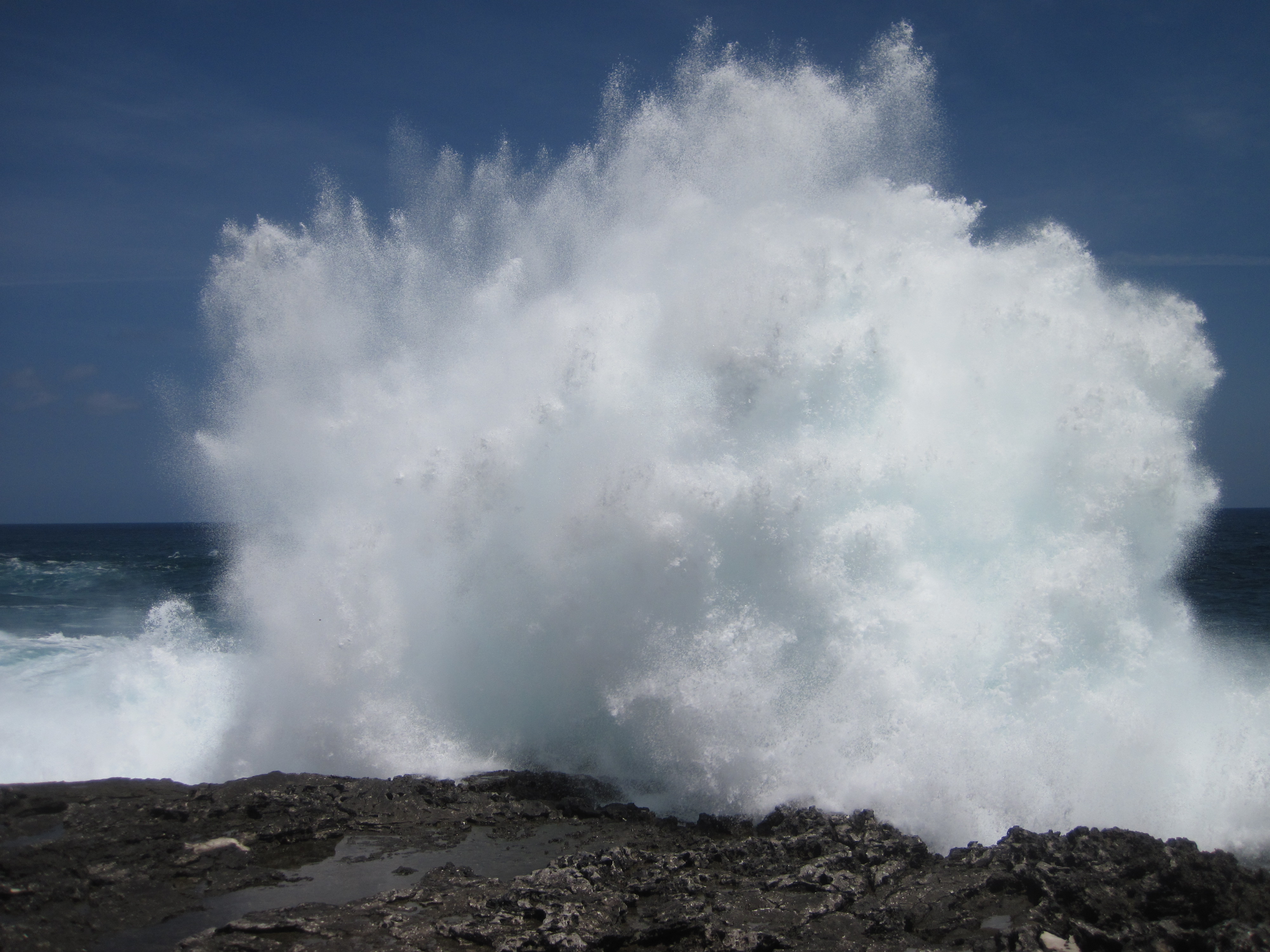
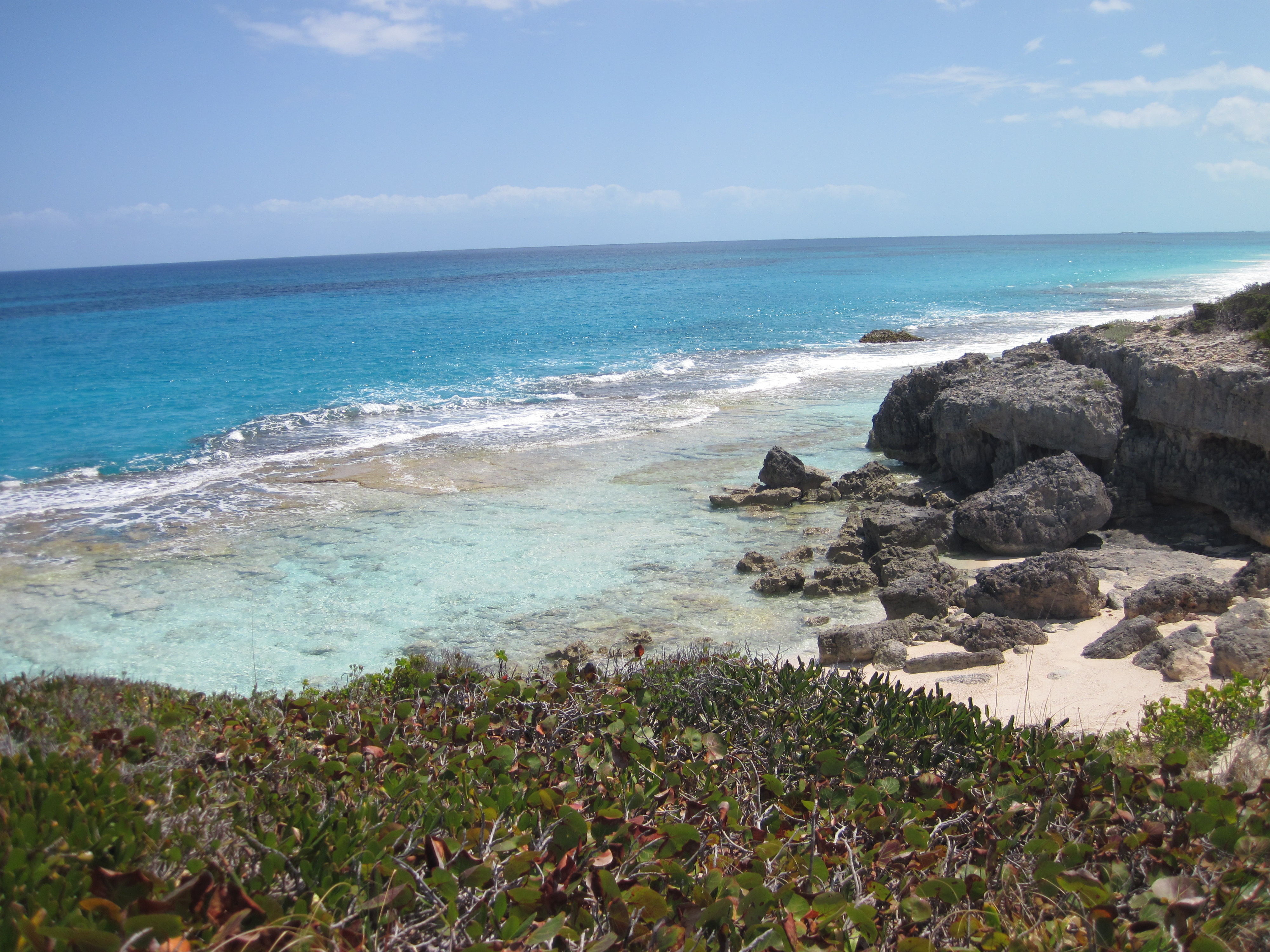
Little Harbor is very rugged, but we climbed up onto the barrier land to watch the waves crash on the Atlantic coast.  This photographer got soaked standing in the path of the exploding spray (see photos below) and we searched the tidal pools for sea glass.  After that we searched for coconuts, finding a couple, but unfortunately they weren’t any good when we cracked them open.

Imagine our surprise when that night we watched another boat join us in Little Harbor! We spoke with the gentleman, who is singlehanding with his dog, the next day.  He said the inlet was “interesting” which I interpreted as “incredibly dangerous” and that he thought the third wave that hit him was going to broach the boat before he popped into the harbor.  He was lucky, and I hope that luck doesn’t give him more confidence, in those conditions, if he broached and hit the reef his boat would be lost in seconds.

As predicted, Friday morning the swells subsided and we exited Little Harbor without issue.  The wind was right for our run to Long Cay near Crooked Island and we started the morning sailing at over 6 knots but it subsided over the day.  We anchored off of Long Cay that evening at dusk, and I saw a glimpse of flamingos in the distance before the light failed.  The bright orange moon rose on a dead calm bight while the area clouded up.  Later that evening we were treated to an impressive lighting storm as the squalls preceding a slow moving front finally hit us. We were happy to be out of Little Harbor and happy to be in the Bight of Acklins on this Good Friday.

On Saturday we had to abandon the flamingos so that we could sail on to a more protected anchorage bight before the true front arrived.  I promised Sabrina that we would return to approach the bright pink birds and see Albert Town. We sailed wing and wing dead downwind across the Bight of Acklins towards Camel Point.  The water varied from 9 to 11 feet over beautiful sand as we watched birds circling and a lone dolphin play off our bow.  By this time I had given up on the freezer, and we tried to motor as little as possible, so we raised anchor under sail power only.

When people talk of the Bight of Acklins the words “remote,” “lonely,” and “deserted,” typically come up.  Imagine our surprise when upon setting our hook we saw another boat motoring to our anchorage? We recognized it as a Dutch boat named “Mauyva” which is very distinctive because it is aluminum. We had seen them a few times before in Georgetown and Calabash Bay. As we launched our dinghy and Sabrina prepared to head to town, they dinghied over exclaiming, “The third time we see your boat we have to come over and say Hello!”  We all laughed and decided that this is a good rule to cruise by….

Stay tuned, more to follow in a future installment when Sabrina picks up the narrative!

Battery Update: While the batteries are still not operating at full capacity, either my discharge trick worked or the solar is keeping up. (Merrill, I know you’re laughing at me right now, because it seems they fixed themselves!) The important thing is that our engine starting battery is working well, and the house batteries are working well enough that we were able to run the autopilot all last night in the rough weather.  The other good news is that our freezer is now working again, our food is frozen, and in fact I just emptied the ice tray! We’ll have cold drinks as we relax here in Georgetown for a few days.

Categories: Uncategorized | 2 Comments

Farewell Georgetown (for now)

Today we’re headed east to either Calabash Bay or Conception Island.  We’ve been hanging out waiting for wind when we realized that when there’s no wind, we should be scuba diving! The first place we both thought to go was the wall at Conception, so we’ve abandoned the sails and we’re motoring out in calm seas to the anchorage.  Hopefully it’s not too crowded when we get there, Elizabeth Harbour here in Georgetown looked ready for water-skiing this morning it was so calm, so I bet other people have our same idea.

We had a good time in Georgetown. We said goodbye to Maxwell and Jen on Saturday and spent Sunday doing our U.S. taxes, I found that a fitting activity for April Fool’s Day.

One of my aunts posted a comment asking if Georgetown was like Fourth Lake in the Adirondacks, (which was the last place we were able to see each other) and it’s not…. But, it’s exactly like “The Pond” which is just down the road from Fourth Lake!  Strangely, Georgetown is the closest thing to a state-side waterfront town as we have encountered in the Bahamas. Whether it’s Put-In-Bay, Annapolis, Portage Lakes, the North East River, Hamilton Lake, Havre de Grace, or the aforementioned “Pond” they all have similar aspects.  Before you think I’m crazy, hear me out! All you need to do is simply replace the bluegills swimming around the docks with chub and needlefish, swap the freshwater for salt, the fudge (or ice cream) shop for a straw market, and add your typical boaters milling around the docks and bars.  Lake Victoria here in Georgetown has a bunch of pontoon boats, vacationers renting boats to go to the waterfront bars on other islands, three liquor stores, and the one central grocery trying to carry all the foods you love from home. To complete the illustration, nobody pays attention to the “No Wake” sign either! Check out the photos and feel free to comment if you think I’m crazy.

Georgetown is a cool place to visit, I can’t imagine being here when there’s 600 boats or when the wind is howling, but it definitely is a great place to stop in for provisions, and we’ll probably be back in two weeks for more free water (an awesome luxury) and fresh produce from the street-side vendors (another great perk.)

On a side note, lobster season ended on Saturday with a whimper (much like Ohio State’s basketball season,) but we were able to take the tail that Maxwell grabbed and turn it into some delicious sushi. (There’s no photographic evidence of my first attempt to make sushi, that didn’t work out so well.)  On our way to Conception Island we’ll be targeting tuna to make true sushi, I already have the ballyhoo defrosting on the swim platform!

Categories: Uncategorized | 3 Comments

Georgetown

I don’t think that we’d ever be the kind of people to drop anchor here in Georgetown for 3 months, but I can understand why people do it. The community is very friendly to boaters, there’s a ton of beaches, beautiful hiking paths, and everything in town is very close to make for easy walking.  It’s a great place to get free water, buy some groceries, get some gas, and go to the bank, all in one quick dinghy trip. We definitely like it as a nice place to re-provision (much easier than Thompson Bay/Long Island) and it’s great to hang out with people and meet up with other cruisers.

We’ve played volleyball a few times over the last couple days with our friends on the Chat n’ Chill beach, the matches were very exciting.  In between games you can cool off in the ocean water while rays swim around your legs and over your feet (they’re looking for scraps from the conch bar that’s on the beach.) On Thursday night we went to the party at Peace and Plenty for a last hurrah before we parted ways.  Thursday morning Sabrina and I did some hiking up to the monument and visited most of the beaches on Stocking Island.

On a side note, I passed a Beneteau 393 in the dinghy a few days ago off of the Chat n’ Chill, and it took me reading the name of “Sea Life” and the port of “Sydney” to realize that it was a guy I admire.  Mark has circumnavigated in his 393 and crossed the pirate laden waters of the Gulf of Aden.  He’s also very active on the Beneteau websites and is always willing to offer advice from his experience with his boat.  I stumbled across his blog at www.ourlifeatsea.com and we’ve communicated via email in the past. We talked of things he wished he had while cruising, and things that he didn’t think were needed.

We bid farewell to Dave and Jess this morning as they headed north.  Maxwell and Jen are still hanging out as we all wait for a little more wind.  It’s crazy that a couple of weeks ago we all met while we waited out strong winds, now we get to hang out while we wait out these calm days.  While we await the stronger winds we went snorkeling this morning for the last day of lobster season.  We got one lobster, Sabrina saw a bull shark, that I almost ran headlong into a sawfish (or carpenter shark.) For those scoring at home, that’s 2:1 lobsters versus shark…. not cool.  I was pretty excited about seeing the sawfish, and I somewhat remembered that they were kind of like rays and very rare, but I couldn’t remember exactly what they ate, so I boogied back to the dinghy.

We’re trying to find someplace to watch the Final Four tonight, but I don’t know if anyplace will be staying open that late for the second game.

Categories: Uncategorized | Leave a comment

Jumentos – Part 2

Mutton Fest  (Motto for the festival?  Mutton or Nutton….seriously)

Back when we were anchored in Thompson Bay, we met up with some other cruisers our age. Maxwell and Jen are from the Chesapeake Bay in Virginia, and Dave and Jess are from New Brunswick, Canada. We had to split up for a few days to do various errands, but we met up at the Mutton Fest held at Clarence Town, Long Island on Saturday, March 17th.

Mutton Fest was similar to what would be a small local fair in the states, a celebration of craft and agriculture, with tents displaying and selling the crafts created by the people of Long Island. We enjoyed looking at the various straw creations, jewelry, carvings and homemade jams, jellies and hot sauces. There was plenty of traditional Bahamian food to enjoy as well. One of the best parts was the 5 for $1 conch fritters and the guava duff, a traditional Bahamian desert. They even had Guinness to help us celebrate St. Patrick’s day. We also bought a bag of really hot peppers for $2, the entertainment value alone of sampling these peppers over the coming days was worth what equated to 10 conch fritters.

There were also several events, including competitions for the fastest grouper skinning and fastest conch cleaning, which were quite educational to watch!  In addition, a competition for the best mutton dish was held among the local school children. Because tourism is so central to the Bahamian economy, culinary trade education is very important, and there were some fantastic dishes on display.  After the judging, everyone was able to sample the entries. Several presentations sponsored by the government encouraged local farming and provided education on lionfish cleaning and cooking.  The evening ended with a rake and scrape band and a singer flown in from Nassau to entertain for the event.

Sabrina and I knew we had to be in Georgetown to renew our temporary visas by the 27th (which is where we’re anchored now) so we decided that heading back to the Jumentos for a few more days to fish and lobster would be fun. Maxwell and Jen’s freezer was also getting bare, and they had arrived at the same conclusion, once both boats decided to go, we twisted Dave and Jess’s arms until they came along too.

The Jumentos

We left on Monday the 19th after all boats were readied and we had taken on water and groceries. The sail to Flamingo Cay was largely downwind, and we made great time, even getting to wash the sails in a couple of afternoon thunderstorms.  We anchored off of Flamingo Cay that night with many Bahamian fishing vessels that had been fishing the area over the season.

The Jumentos are excellent for spearfishing and lobstering, and on Tuesday we got to work. Maxwell is a great spearhunter, and I learned a lot from watching him dive and following his search patterns.  We found conch, lobster, hogfish and grouper.

The days were pretty similar.  We’d get up, get some coffee and breakfast, wait till the sun was higher in the sky and then we’d go fishing. After fishing we’d relax and then meet up for dinner, dessert, or drinks at a boat. We went hiking one day on the island and saw the old plane wreck on the north shore. We took the dinghy to the “drive-in” sea cave and then climbed out the back to the top of the island. We hung out on the beach, and one night we even had a bonfire.

One day we were out fishing and a Bahamian diver on the cliffs flagged us down, his outboard engine was stuck trimmed up out of the water and the boat and captain were in danger. Luckily they got the anchor down, before they got sucked out to sea, but they were fully in the “rage” of the waves that built in the cut.  Maxwell and Dave tried to drag their boat out of danger with on dinghy but the current was too strong for the small boat and they took the captain in to the larger “mother ship” to get help.  Sabrina, Jen and I picked up the diver in our dinghy and took him to meet up with the other fishing skiff that came out to help. We stayed nearby to make sure they didn’t need further assistance and there were a few hectic moments as both Bahamian boats had waves cresting all around them. They made it back alright and thanked us for our help. I hesitate to think how long they might have been stranded without a radio if we hadn’t come along.

We had a blast hanging out with people in the remote islands of the Bahamas.  There’s no civilization, but the ladies had fun trading bread recipes while the guys perfected various recipes for rum punches. We shared dinner responsibilities, traveling from boat to boat and generally just enjoyed getting to know people better.  Dave and Jess told us the cool places to go in Nova Scotia while we filled them in on places they need to stop on the Chesapeake Bay. We talked with Maxwell and Jen about cruising in the Caribbean and what we were both planning on doing after cruising. The group split up on Friday when Dave and Jessica made the trip back to meet up with family flying in. We parted with Maxwell and Jen on Saturday but promised to meet up again very soon.

Needing to make it to Georgetown on Monday, on Saturday, we decided to make the most of our last fishing day in the Jumentos. We woke early and did one last snorkeling trip at Flamingo Cay to gather some conch for lunch before moving Joint Venture 10 miles north to Water Cay. Once the anchor was down, we wasted no time suiting up and jumping back into the dinghy for an afternoon snorkeling session. The current was running quickly over some beautiful reefs, so we employed the “drift snorkel” method and let that help us quickly cover large areas of the reef. It did take some swimming to maintain a position once a fish caught our attention, but our efforts were not wasted, and we found a lobster and a nice grouper.  After cleaning the conch and fish, we headed to bed to rest up for our early departure to Georgetown the following day.

Georgetown

We had a beautiful sail on Sunday. We were pleasantly surprised with slightly stronger wind than was forecasted and very happy not to have to motor the whole 45 mile trip. After much debating which path to take back to Georgetown, our route took us through Hog Cay cut, which carries only about 6 feet of water during high tide, so our timing had to be perfect. Fortunately, it was and the sun was high, enabling great visibility of the reefs through the cut, and we passed uneventfully, arriving in Georgetown mid-afternoon.

On Monday we completed the extension of our temporary visas at the immigration office. We then toured Georgetown, bought some items we needed, and came back to the boat for fresh grouper sandwiches.  Georgetown is somewhat like what we imagined, but we haven’t fully been able to “figure it out yet.”  A lot of boats have already left to go north for the winter, so the cruising contingent is not as large. We’re going to try to tour all the hot-spots in town while we gather supplies and then we’ll be headed out for an unknown destination later this week.

Categories: Uncategorized | Leave a comment