H Season

Each spring many cruisers leave the Caribbean to bring their boats north for hurricane season.  For those unfamiliar with yacht insurance, typically there’s an imaginary “line” that  you have to be north of by June 1st, and you can’t cross it again till November 1st. This line is determined by your insurer and may be the Georgia/Florida state line, NC/SC state line, or Norfolk at the most. (There’s also a southern line, somewhere around Grenada or Trinidad.)

So a lot of cruisers summer on the Chesapeake Bay and areas to the north. The Chesapeake Bay has 11,684 miles of shoreline and I’ve heard that it has more safe anchorages than any other body of water on the planet.

But what do you do when the forecast looks like this?

[Click on image to close window]

Irene

I wish I knew the answer to that question! “Hurricane Preparation” is a heavily debated topic, should you pull the boat out or leave the boat in the water? Should you seek shelter in a marina with a bunch of other boats or drop the hook in a protected anchorage away from hard objects that can cause damage? Then there’s the added issue that if the eye of the storm comes up the Bay, we’ll be flooded with storm surge. BUT, if the eye hangs out on the East Coast, the water will be forced out of the Bay and the boats will be laying on mud in the marina.  So what do you do?

I have no idea what the best thing to do will be, but I can tell you what I’ve done for our boat.  For starters, I doubled up our dock lines and laid out extra dock lines and fenders for use where they’re needed during the storm.  I folded up our canvas bimini and the dodger has been removed to lessen the windage on the boat.  I made sure the bilge pump was running well, and nothing below decks would cause damage if it shifted during the storm. The sails were tightly wrapped and lashed to prevent unfurling, and everything that was on deck has been stowed or tied down. So basically, in sailing terms, we “battened down the hatches.

I hope the precautions I took will help our boat make it safely through this storm. It would be even better if Irene loses intensity before it strikes land, but we’ll have to see what happens. Like Jimmy said, we’re just “tryin’ to reason with hurricane season.

Categories: Uncategorized | Tags: | 2 Comments

Keeping Cool

As I’ve mentioned previously, we have a large freezer and a separate refrigerator on Joint Venture.  There are cruisers who say that refrigeration is a luxury that they don’t need, but I love having cold storage.

To explain for those readers who are landlubbers (or worse yet, motorboaters :)) even if a sailboat has refrigeration, it’s not your normal over/under- fridge/freezer combo. Normally on a sailboat there’s a single box where everything you want to keep cold resides. You put your ice next to the cooling plate, and your lettuce on the other side of the box away from the cooling plate so that it doesn’t freeze. Maybe there’s a partition or two to try to keep the two sides separated.  This leads to a guessing game of “How far should I put milk so it doesn’t freeze and also doesn’t spoil?” Or “If I remove this bag of ice how much will that affect the remaining items, will they freeze, or will they now not have enough residual cold to keep from spoiling?”

When we originally found our boat, the freezer/fridge combo seemed like a great opportunity to enjoy some of the same comforts aboard as you find living on land.  The separated system allows us to keep chicken breasts and ice frozen solid and veggies crisp and fresh.  To paraphrase the old McDonald’s BLT commercial, “The frozen stays frozen and the cold stays cold.”

A few days ago I defrosted the freezer and rearranged some stuff to start thinking about how we would manage things when we head out.  One cool product that we’ve found to keep things even colder is “Techni-Ice.” These sheets allow you to lay them around the inside of the freezer to further help the freezer’s insulation.  We also leave a few sheets on top to keep all the cold from escaping when we open the freezer.  These sheets work great and we even have a half gallon of ice cream staying frozen in the freezer right now. We also found a cool little silicone ice maker that makes ice without the hassle of the usual ice trays spilling everywhere.  The “Ice Orb” is great, it doesn’t spill when tilted and it freezes quickly, you can even chill a bottle of wine (if you’re into that sort of thing.)

The one disadvantage is that this system does take a lot of electricity.  But I will gladly trade some extra power for ice and cold beer!

Categories: Uncategorized | Tags: | Leave a comment

Rock the Vote!

The good people over at Sailrite are currently having a photo contest regarding projects in need of repair.  First place takes home a $250 gift certificate good for use at Sailrite.  Needless to say, between Sabrina making new cushions, modifying the dodger, and the repairs needed for the bimini, we’re getting VERY familiar with Sailrite, and we’ll definitely put that $250 to quick use!  So vote HERE.  Our entry is titled “Bimini Repair” and uses the picture below.  If the hyperlink didn’t work, here’s the full path: http://wildfireapp.com/website/6/contests/139662

Nermal watching the birds

For those of you that may be unfamiliar with Sailrite, they sell everything you need to repair sails, canvas, and cushions (to mention a few things.)  Not only that, but they provide in-depth videos on how to use their products to make do-it-yourself repairs or products, and most of the instructions are FREE. Naturally, we gravitate to high quality products which are designed for the DIY-er that also include free instruction… so we spend a lot of time on the Sailrite website.

Please stop over to Sailrite and vote for us, if we win you’ll get to follow along as we repair our bimini and prepare for mounting our solar panels above it!


Categories: Uncategorized | Leave a comment

Under Pressure

Editor’s note:  I started this blog post on July 30th, and had to heavily edit it based on the problems that I encountered. Read on to see why your average boat project takes 2.5 times as long as you think it should!

What follows is the first of (hopefully not too) many blog posts on diesel engine repair. Some of you might wonder why I’m writing about this mundane topic? For starters, I’m documenting it so I can remember what I’ve done in the future! The next reason would be to hopefully provide some information to other sailors that might have similar situations. Finally, I want this blog to illustrate our full journey.  Many cruisers joke that “Cruising is fixing your boat in exotic locations….”  Be aware folks, this blog won’t be all palm trees, lobster, and sunsets.

So here it is, ‘The journey of a thousand miles begins with a single socket set…’ or something like that. Stay tuned for the excitement of beautiful engine compartments and faraway grease covered tools!

The Westerbeke manual said that the easiest way to determine engine health was to perform a compression test. I quickly googled Westerbeke’s recommended compression attachment, and found it listed at around $110, plus I would need to borrow a compression gauge.  Next I popped over to Harbor Freight online for a diesel compression kit.  $29.99 and few days of shipping later, I now have a fancy new kit.  (Note, for the reasons that follow I don’t advocate Harbor Freight for anything you want to last, but I only needed this kit to last for four tests, so I thought I would be okay.  I have about a 50/50 success rating with Harbor Freight, either I’m happy and the tool gets the job done, or I’m angry at the packaged piece of junk they sold me.) 

My buddy, and dock neighbor, Bill, says he’ll give me a hand with the compression test over the weekend. Having never done one before, it’s nice to learn tricks and tips from a guy with a lot of experience on various engines. So I do my part to get the engine ready for testing and follow the steps outlined in the Westerbeke manual:

  1. Warm up engine
  2. Turn off fuel supply
  3. Shut raw-water seacocks
  4. Remove (now very hot) glow plugs
  5. Open brand new diesel compression tester
  6. Attach proper fitting into Cylinder 1
  7. Attach compression tester to fitting

And here’s where things get interesting.  At this point Bill hits the ignition on the engine, and the quick-connect on the tester separates itself from the fitting.  Forcibly. We also have another problem, the pressure release valve isn’t working on the tester.  So there’s about 500 psi in the tester that we have to release. That took some swearing.

We analyze the system and determine that the fitting we need was poorly machined and won’t seat properly on the quick connect.  But never fear, because Harbor Freight has a 100% guarantee on their tools!  It’s a decent drive, so the compression test is abandoned for a week until I can get back to the store.

Fast forward a week, the visit to Harbor Freight has been made, there are no questions asked, just a simple exchange of my non-descript red case for another non-descript red case.  I check the fitting in the parking lot, it is machined properly and fits tightly. I’m back in business!

This weekend my friend Steve is in town and he’s going to help me with the test.  So I reassemble the engine, repeat steps 1 through 7 above and  test the first cylinder: 520 psi.

Test second cylinder: 0 psi.  The air release button won’t close and therefore won’t allow the tester to pressurize. At this point two engineers proceed with multiple attempts to make this tester work. More swearing. Final result is the abandonment of the test for another week.

Fast forward another week, the visit to Harbor Freight has been made, there are no questions asked, just a simple exchange of my non-descript red case for another non-descript red case, they must do this a lot…. I assume ‘the 3rd time’s a charm.’

This morning I skip reassembly and steps 1 through 4 and dive straight into the compression test.The tester actually allows me to get through all 4 tests without too many problems (the tester still flies off the fitting once it is pressurized. Still forcibly.)  Results as follows:

  • Cylinder 1: 520 psi
  • Cylinder 2: 520 psi
  • Cylinder 3: 525 psi
  • Cylinder 4: 540 psi

The engine is great, excellent pressure and less than a 10% difference over the cylinders!  FINALLY.

Total time for me to do the test by myself this morning? Less than an hour.  (And that was with me re-installing the companionway steps every time I had to run up to the cockpit to hit the ignition.) Total wasted time because of poor quality tools?  8-10 hours.

I take two positives away from this process, I know the compression on the engine is great, and I know how to replace a glow plug in my sleep!
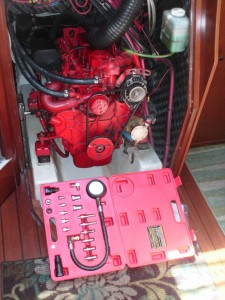
Engine with Compression Tester

Categories: DIY | Tags: | Leave a comment

Nermal or Nemo?

With fewer than three months to departure, our lives are full of questions: where to store scuba tanks, how exactly will we mount the solar panels, where will we even BE in six months?

And… can our cat swim?

We discovered the answer to that last question bright and early this morning.

Nermal is a relatively new addition to the crew. He was one in a litter of stray kittens born at Bohemia Bay  last summer. He was very friendly and joined the crew in November as a “foster kitty.” At least one of us planned to find him a permanent (landlubbing) home. I repeatedly pointed out all of the extremely logical reasons why we should not have a cat on board: fur, limited space, a litter box, added travel complications… fur. Brad convinced me that we should keep him “just a little longer.” My husband knows me well and quite quickly, I was in love and our kitty had a permanent, floating home.

Except for the occasional snowball we brought inside for entertainment (yes, we got a little bored with no TV and plenty of snow last winter), Nermal had no interest in the outdoors when it was cold. But since summer has arrived, he enjoys hanging out in the cockpit, chasing spiders and watching the sparrows try to nest in our mast (that’s another post entirely).

So early in the morning, I usually let him hang out, leaving the companionway open and checking on him every few minutes. So far, without incident. This morning, though, I checked on him one minute, and he was sitting primly on top of the coachroof. I went back below to make coffee, popped my head up no more than a minute and a half later, and he was gone. I frantically scanned the empty dock and listened to the early morning, mid-week silence of the marina. My heart dropped into my stomach. I turned and looked around the water, and there he was, swimming like a little orange otter in the middle of the fairway. I ran down to the dingy dock he was heading for and forced myself to pause before diving in after him (the dead fish floating 3 yards away helped). He was moving like a little speedboat and didn’t appear to be struggling, so I just encouraged him until he was close enough to grab.

Both of us drenched and relieved, we climbed the ladder and headed back to the boat for a bath and some treats.

So now we know our cat can swim like an otter, and being sea-loving people, we couldn’t be happier. Maybe someday he will even follow in the pawsteps of this feline trailblazer and enjoy fish from a different perspective!

I hope the kitty and I have both learned something from this. For my part, I’m revoking unsupervised outdoor privileges for now, and I’m moving “Make Cat Rescue Net” to the top of the TO DO list.

Categories: Uncategorized | 6 Comments

Dinghy Racing

We’re told that a dinghy is one of the most important pieces of equipment a cruiser brings along. Previously I’ve written about some of the things that I want from a dinghy and how we have tried to figure out exactly what we’ll need in the future.

When we purchased Joint Venture, a dinghy and outboard were included. The dinghy was a West Marine 9′ PVC high pressure air floor that fully rolls up into a small, easy to carry package. (The dinghy would actually fit into one of our lazarettes.)   The outboard was a 5hp two stroke Mercury.  Originally we thought this dinghy was nice, it was easy to store and lightweight, but the dinghy wouldn’t go fast with two people, so we never used it, and we put it into storage.

An additional problem with PVC dinghies is the fact that they don’t last long in bright sunlight, therefore they aren’t recommended for long term use in the Caribbean. Over the winter we found a used Apex 9′ dinghy made out of “Hypalon” on Craigslist.  This dinghy still rolls up but has a folding aluminum floor that hopefully would help it move faster than the PVC dinghy with our 5hp Merc. I inflated the Apex a few weeks ago to see if it would hold air long term, and it did!

So, over the last week I dug our outboard out of the storage facility and blew off the dust.  After a few tweaks to the engine and some new gas, it is running great! (This was actually shocking, I even bought a carburetor rebuild kit and didn’t need to use it, I’ll save the kit for later.) 

But we have another problem, the new Apex just isn’t big enough or fast enough for what we think we need.  The Apex was a step in the right direction, it’s scary fast with just me in it, but with two people the top speed is only 6mph. That’s not going to work if I’m trying to bring ice back to the sailboat on a hot day! The Apex would be the perfect dinghy for a short ride to a restaurant on the Bay, but we don’t think it’s going to work for us.

Here’s what we want from our dinghy:

  • Small, lightweight and easy to manage
  • Suitable for scuba diving (two persons, two tanks, etc.)
  • Enter areas where the sailboat can’t go due to depth
  • Grocery runs, and runs to shore for up to four people
  • Ability to explore an island from a single anchorage
  • And…. Affordable $$$

The biggest problem with our list above is that a bigger dinghy that will move fast and work for scuba diving is not lightweight or affordable.  So we need to strike a balance, and that’s where we are now.

Our friends say that a cruiser’s dinghy is their car.  Right now we need to figure out if we need an SUV or a hatchback.

One member of the crew hates the noise of the engine and prefers that I row the dinghy:

Nermal hated the engine noise


Categories: Uncategorized | Leave a comment

The Interwebs

(Special thank you to icanhascheezburger.com for the above pic which has been slightly edited to reinforce my point.)

Recently I’ve expanded our online presence, we have this shiny new blog, new email addresses, a domain name, and I’m trying to sell everything we don’t need on eBay or Craigslist.  One thing is a constant throughout all these areas: scammers.

I can’t tell you how many iPad 2’s I’ve won, how many people want me to pay me to write blog articles for them, or how many people guarantee me that I could rank better in google searches! It’s amazing because at some point, they must turn a profit on those things, and I wonder HOW?

Now don’t get me wrong, I’m a product of the internet age. I couldn’t live without google. I follow blogs. I prefer emails to human interaction. I have signed up for every “reduce paperwork, receive your documents electronically” that I can possibly find. And we have this blog to keep friends and family informed on our adventures. So, I’m not afraid of someone stealing my bank accounts, and I’m not frantically dialing “LifeLock” to Relentlessly Protect My Identity.

But I just can’t shake this feeling that the internet is one huge scam waiting to happen. Even legitimate people respond to local Craigslist ads with emails like, “Will you deliver this 200 miles out of your way for a $40 item?”  Guess what? “NO.”  And don’t get offended when I say, “NO.” My ad says, ‘local pick-up only,’ learn to read carefully before you try to purchase things on the internet. Maybe these people are the ones responding to a nice Nigerian Prince who is looking for someone to help him move a large sum of money?

Most recently a guy in Australia tried to purchase my ski boat. (This may come as a shock, but the deal fell through….) The eBay ad clearly stated, ‘US buyers only, buyer responsible for pick-up, cash due at pick-up, etc.’  Yet he felt compelled to purchase the boat, and he got offended when I wouldn’t accept anything other than cash!

And that’s why I’m annoyed, even legitimate people are coming across as frauds. It’s hysterical to read articles on how best to sell things on the internet, the most frequent answer is ‘don’t.’ I want to believe people are honest (just like by boat buyer in Australia), but the overwhelming trend seems to be that they aren’t.

So be careful out there, trust your instincts, and if you ever get an email from me saying that I’m locked up abroad and need money, be sure to call me to confirm.  Follow this guy’s example:

funny pictures - U  say  u  frum  Waste Manajement  and  Collekshun?  Letz  see  sum  ID  buddy.

And never forget the best use of the internet – poorly captioned images of cats doing funny stuff.

Categories: Uncategorized | Leave a comment

“3 Months” sounds better than “98 Days”

“99 days left till we leave on our cruise, 99 days left to go!
No time to be lazy, try not to go crazy, 98 days left till we leave on our cruise!”
                
(Yes, I realize I might be leaning towards the crazy side….)

The days keep slipping away, I try to maximize what gets done, and plan ahead for what comes next, but it is a daunting task.  Something I realized is that when I say, “We’re leaving in 3 months” it sounds like a lot longer time frame than “We’re leaving in 98 days.” I don’t know why “3 Months” sounds better, but from here on out I think I’m going to say that.

I received some good news this morning, the carb rebuild kit for our dinghy outboard and the alternator and pulley kit for the Westerbeke diesel both arrived. I’m ecstatic about receiving the alternator parts because that means that I can finalize some things on our diesel engine.  An added bonus is that I get to work inside in the A/C in this heat!

More to follow tonight with pictures of the alternator installation with our brand new serpentine pulley set.  This 160 amp system built by ElectroMaax and coordinated by Cruise RO Water and Power will definitely be worthy of its own blog post!

Also, we just passed 200 unique visitors in our last 30 days! I can’t believe that we’ve had that many people stop by, hopefully we can keep things interesting for the next 98 days until we shove off.  Upon departure I hope the posts will just about write themselves and the pics will be far more interesting than engines, alternators and gelcoat repair.

Stay tuned because in the next couple weeks I’ll be rebuilding my first carburetor.  Those of you that know my mechanical prowess should realize that this should be worth a laugh….

Categories: Uncategorized | Leave a comment

Time Marches On

Our countdown clock doesn’t care that the heat index is 105° and that the Weather Channel strongly suggests that I stay inside. With only double-digit days remaining, it’s time to start checking items fully off the list.  I have a lot of projects that are halfway there, the goal is to get them fully to the finish line.

This is a tough job when the heat is high, but I have a few things that I can finish up inside the boat.  We’ll see where the day goes, but hopefully at the end there are fewer things on my ultimate to-do list.

Categories: Uncategorized | 8 Comments

Hot! Hot! Hot!!

Just like a majority of the country, Maryland is in the midst of a heat wave.
Buster Poindexter said it best:

While trying to keep cool, I’ve noticed something:  The hotter it gets, the more our companionway slider sticks. The companionway is the Plexi-glass pieces that slides open and then lift out to enter the boat.  You can see it here:

The Companionway

My hypothesis is that as the boat gets hot, the hull expands and the companionway rubs against the “turtle shell” that covers it.  So, now I’m removing the “turtle shell” to grind an 1/8″ off the base.  You can see how the “turtle shell” is rubbing on the slider here:

Note the White Gelcoat Streaks

I have my reasons, the heat is unbearable now, but the A/C in the boat is still working.  When we go cruising, the A/C will be off, and therefore the hull will be even hotter (expand more.)  I’m afraid that the slider will stick to the point that we can’t move it!

Now, removing the “turtle shell” sounds easy, except for the fact that I have to remove the traveler first. (Traveler is the gray thing with lines running through it in the photo above.) Once again, not a problem, but to get to the nuts that hold the traveler down, I have to remove access hatches in the headliner of the boat.  One side is easy, seen here:

The Easy Side

The other side requires me to take off headliner pieces to get to the nuts, seen here:

Removing the Headliner

I’ve done it before (yes, I should have ground the 1/8″ off at that point) and it’s not too tough…when I have help. Unfortunately, Sabrina is out of town so the only help I have is a kitty that keeps attacking my screws as I pull them out:

My Helper

So, as you can see, a simple 1/8″ adjustment can spiral quickly out of control. But now the nuts are removed and the headliner is replaced, everything is back to normal.  Except for the unbearable heat.

Back to Normal

For the blog followers, I’ve also added my first post tag, “DIY.”  This post tag will most likely fill up quick, but should help to remind me of what I’ve done, and how I did it. Hopefully I can also help others out as they are working on their own boats.

Categories: Uncategorized | Tags: | 2 Comments